


Situation: Crisis in Manual Operations
The regional wallpaper business was severely constrained by deep operational inefficiencies inherent to its manual, paper-based workflow. This chaotic process directly caused high resource waste, excessive delays, and severe customer and employee frustration.
-
Massive Time & Resource Waste
The process was entirely manual: sellers wasted 5−10 minutes per customer calling the warehouse for inventory, orders were registered manually in Excel, and cash was counted by hand. This pervasive manual work led to a resource waste exceeding 40% of business expenses.
-
Customer & Courier Friction
Manual fulfillment caused significant delays for customers, leading to high frustration. Furthermore, couriers relied on paper lists and memory, with new couriers taking up to 4x longer (5 mins → 20 mins) to locate products, compromising delivery speed and consistency.
-
High Error Rates & Unaccountability
The paper-based system led to frequent, costly errors (e.g., wrong products delivered, order conflicts). Crucially, debt and sales money were calculated manually, causing frequent money loss and internal disagreements due to the lack of organized accountability.
Task: Systematize Operations & Mentor Talent
My mandate was twofold: 1 - Systematically replace the manual operational chaos with simple, effective digital tools to achieve critical financial savings; and 2 - Lead and mentor a team of six junior designers through a full-stack, real-world UX project.
-
Automate Friction
Eliminate complex manual sorting and routing tasks to free up driver time and significantly reduce delivery errors.
-
Adoptable system
Design a simple, custom system that is immediately adaptable and highly usable for staff (sellers, couriers) who may lack strong technical literacy, ensuring high adoption.
-
Talent Development
Implement a rigorous, practical UX process (Design Thinking) to transform the team's theoretical knowledge into the real-world delivery skills needed to solve a multi-million dollar business problem.
Action: Design Thinking, Systemic Solutions, and Mentorship
I led a team of six junior designers through the 5-stage Design Thinking framework, maximizing their practical skills while simultaneously designing and validating a system to replace the chaotic manual operations.
Strategic Leadership & Mentorship (The "How")
-

Documenting the chaotic, manual inventory environment of the business. Mentorship Framework
Established the 5-stage Design Thinking framework as the core project structure, ensuring all six junior designers gained hands-on, end-to-end UX experience.
-
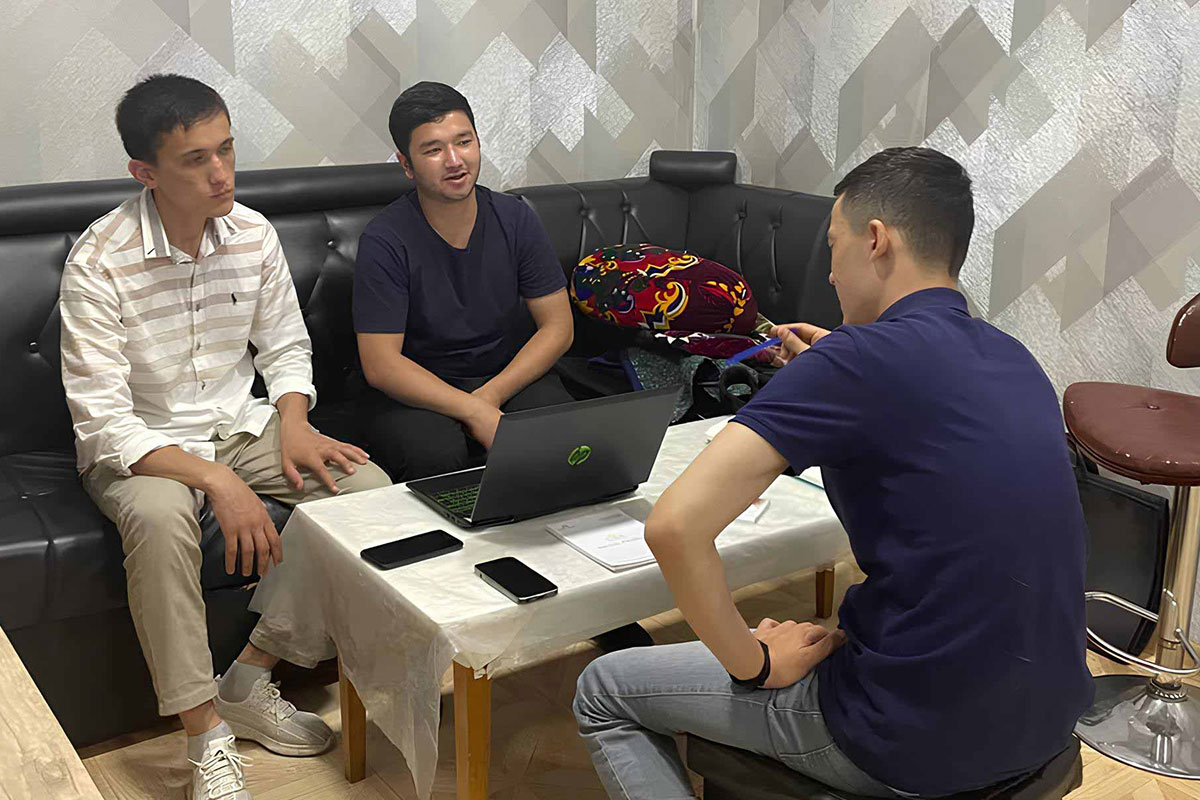
Quantifying operational waste via mentored stakeholder interviews. Deep Contextual Research
Directed the team to utilize a mix of research methods, including Stakeholder Interviews and Contextual Inquiry in the stores/warehouses, to precisely quantify the minute-by-minute waste in the manual process.
-

High-fidelity prototype testing in a high-stakes operational environment. Iterative Validation
Emphasized Contextual Usability Testing with couriers, store managers, and warehouse staff. The team used low-fi wireframes and high-fidelity mockups to validate solutions in the actual work environment, ensuring high adoption.
End-to-End System Design (The "What")
-
Warehouse Management System (WMS)
Created an end-to-end web application to control orders, cash flow, and inventory, automating sales and accounting calculations and eliminating 45−60 minutes of error-prone manual work daily.
-
Seller Efficiency App
Designed a mobile application allowing store managers to instantly check inventory and register orders, eliminating the need to call the warehouse and saving over 300 minutes of daily call time.
-
Operations Optimization App
Designed a mobile app that provided immediate product location within the warehouse, reducing order fulfillment time by up to 65% and making new couriers efficient from day one.
-
Executive Transparency App
Developed a mobile dashboard for business owners, providing real-time, optimized metrics for quick and informed decision-making.
Results
The systemic digital transformation delivered massive financial and operational returns, demonstrating the direct ROI of strategic UX leadership and mentorship.
-
Financial ROI & Income Increase
The solutions eliminated unnecessary expenses, resulting in a 31% increase in company income and achieving over $1 Million in expense savings within the first year.
-
Systemic Quality & Error Reduction
The integrated system reduced the probability of execution errors by 97%, completely eliminating costly issues like product leftovers and ensuring accurate financial calculation.
-
Operational Efficiency Gains
Order creation time dropped by 55%, and product delivery time (warehouse to customer) decreased by up to 65% via the new digital courier and seller tools.
-
Design Leadership & Mentorship
Successfully mentored and transformed a team of six junior designers, providing them with essential real-world skills through the structured delivery of a multi-million dollar impact project.


Key Learnings
-
Leadership through Guided Empowerment
Mentoring required a "lead by example" approach; I had to gradually overcome the team's initial shyness by first modeling the UX techniques and then deliberately pushing them into the lead roles during research and testing. This demonstrated the importance of patient, adaptive leadership to build talent capacity and confidence from the ground up.
-
Mentorship as a Deep Skill
Bridging the gap between theoretical and practical knowledge required deep expertise and cross-cultural translation. To teach the team (who lacked foundational UX knowledge and spoke a different language), I had to completely internalize complex UX principles, proving that teaching enhances one's own mastery and demanding detailed, high-stakes communication skills.
-
Strategic ROI vs. Design Perfection
The core lesson was that business viability trumps design perfection. The business achieved $3 Million+ in savings by implementing a minimal, $10K version of our design, rather than the full, $100K build. This cemented the importance of Minimum Viable Product (MVP) thinking and strategically prioritizing solutions that deliver immediate, quantifiable financial impact.
-
Adaptive Management & Trust
Effective leadership is about leading, not just managing. I learned to carefully balance scheduling constraints and the team's capacity, prioritizing patience and trust over speed. This reinforced that the true task of a leader is to empower and wait for results, even when I could personally finish the task faster—a crucial skill for building scalable teams.
